Centenary World Cruise Day 78: Freemantle

Today is our last stop in Australia. Freemantle is a suburb of Perth, and what we could see of the town from the ship was lovely – a lot of older-looking buildings, a lot of trees and grassy areas. We’d booked a walking tour, and as it started, it was already hot out. Our guide told us about something called the “Freemantle doctor,” which happens when the ground heats up quickly, the hot air rises, and the rising air sucks in a cooling breeze from the ocean to the west. It was probably over 90 when we set out, but by about 11:30, it had cooled down at least 10 degrees and the breeze was refreshingly cool.
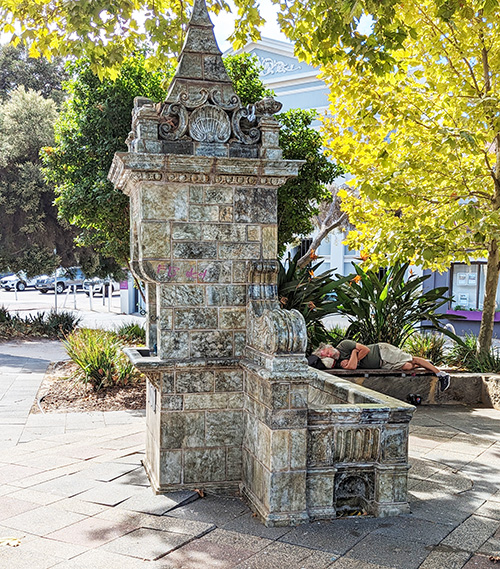
An entire fountain made of Doulton china

Freemantle has a lot of pretty buildings that were built during their gold rush, and a lot of them are fairly well preserved. What’s really well preserved, though, is the prison. Apparently, when the rest of Australia decided they were sick of being sent convicts, Freemantle needed a lot of free labor, so the government began shipping the convicts there. The very first thing the convicts had to do was to build their own prison, and the only thing they had to build it out of was blocks of locally-mined limestone.

Iron sculpture of prisoners being brought in

The prison was completed in 1855, which was not a terribly enlightened time for the criminal justice system. Shockingly, the prison continued to operate until 1991.

After our tour wound up, the Pirate and I peeled off from the group and walked around the district near the university. It was a cool blend of coffee places, used clothing and book stores, youth hostels, fun-looking bars, and a few touristy-looking shops.
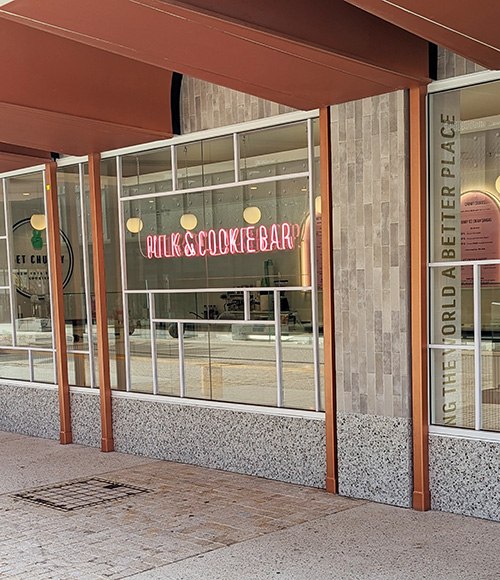
This needs to be franchised in the US!

I realize that, while I like Europe and the Middle East for the history and the museums, Australia just generally feels more relaxing. There’s no more history here than there is in California, and the Australians aren’t hung up on it. The difference between Australia and Britain feels a lot like the difference between New England and California. In California, we know that people love us for our nice weather and good beaches and plentiful vegetables, whereas in New England, they want you to know how historic they are and look down their noses at anyone who isn’t well versed in their history.

I mentioned a few weeks ago that after setting our clocks forward every few days so that our days were only 23 hours long, I was looking forward to the return trip where our days would be 25 hours long and we could sleep in every day. Even then, I knew that something would suck, I just wasn’t seeing it yet. Once we left Sydney, we started traveling westward and so getting those hours back, and I’ve figured out what sucks. I’m wide awake at 5:30am and nothing’s open – I can’t get a cup of tea or go for a swim or anything. And by 5:30pm, I’m starving for dinner which won’t be served for another hour. Then I’m ready for bed at 7:00pm.

The Good Old Days

I often find myself thinking about/arguing over how modern life is different than ancient life, and whether it’s better or worse. Modern life is full of mindless violence, out-of-context sex, artificially engineered diseases, inverted food foams…It’s no wonder modern people look back to times they thought of as simpler. But there’s not a single popularly-romanticized era that didn’t have its own problems that were arguably worse than any we have today.

The Paleolithic period, popularized by the Paleo diet, promises and end to acne, autoimmune disorders, cancer, heart disease, diabetes and any other chronic degenerative disease. It supposes that prehistoric man lived in a veritable paradise of wonderful health and harmony. But the average lifespan of a human living 10,000 years ago was roughly 35 years for men and 30 for women. They were subject to hookworm, malaria, and occasional anemia, and women often died in childbirth. Worst of all, accidents like broken bones, deep cuts and infected teeth killed people slowly and (I would imagine) painfully in a way they don’t now. Can you imagine dying from a blood infection brought on because you’d cut the bottom of your foot on a rock and then had to keep trekking? If you can, keep it to yourself.

Ancient civilizations like Egyptians, Mayans, Incas, Celts, Anasazi are full of amazing technologies and interesting art and science that lead people to insist that they had knowledge that we have since lost. Possibly wisdom gained from extraterrestrials. But all of those civilizations had catastrophic wars with their neighbors, and illnesses common to large populations living in close quarters, like tuberculosis, were common. Slavery was common in ancient civilizations, often a consequence of war where the conquered group became slaves to the conquerers. Childbirth and infancy were still perilous, and infection continued to carry off the wounded.

Perhaps you’re a fan of ancient Greece and Rome? Well, in addition to the invention of philosophy and politics, they saw the rise of patriarchal societies that treated women as property. Near-constant warfare (made easier and more efficient by inventions like the stirrup and teed saddle) and more crowded living conditions, always a fertile breeding ground for disease, were abetted by (in Rome) lead in the famous Roman plumbing that is thought to have contributed to the fall of Rome.

The Middle Ages? Well, they weren’t called the Dark Ages for nothing. More war. More disease. Education reserved only for the rich and the Church. Women’s rights enjoy a brief resurgence, but childbirth and infancy are just as dangerous as ever. Improvements are made to warfare (like the castle, muzzle-loaded cannons, and the codification of battle strategy and tactics), but not so much to medicine. And let’s not forget the plague.

The Renaissance may have seen the emergence of amazing developments in art, sciences and medicine, but it also saw the rise of European Imperialism, bringing with it genocide with both weapons and diseases.

I could go on and on, but the point is that the evils we have now – intolerance, political intrigue, war, fear, anger, stupidity – have always been part of the human landscape. There is not a single period in human history in which people have enjoyed perfect health and harmony, despite what people may wish to believe about their favorite historical period or culture. I don’t care whom you idolize – they had wars and diseases and if you had been part of the 99%, you would have been not only a good deal more poor than you are now, but you would likely have died not only earlier but a good deal less comfortably.

And in fact, people now have a demonstrably higher standard of living than ever before in history. Better education, more knowledge about healthcare and the impact of things like basic hygiene and innoculations, better methods of distribution for nearly everything mean that even poverty looks much wealthier than it has at any time in history.

What I’m trying to say is that we’re not special. We’re not smarter than our ancestors, we’re not more civilized. We’re also no less hostile, no less fearful, no less angry. The one thing that we are, and that our children will be after us, is more efficient. If we manage to wipe out humanity, it will be because we’ve spent all of our thousands of years of history distilling the most efficient way to do it.