Disestablishmentarianism

Three weeks or so ago, my right hip went out. It hurts to walk. It hurts to bend over. It’s not so much that the motion itself hurts, although it does. The worst part is that whatever muscle lifts the leg forward is weak. My right leg has about a quarter the range of motion as my left leg. It means that I limp even when I’m not in pain, and that my balance is shot.

But for three weeks, I’ve been putting off going to the doctor. At first, I told myself that I had pulled something running. It’s true, the problem showed itself the day after I had done my first 3-mile run in a couple of weeks. I took hot baths, put compresses on it, took ibuprofen. The hip would feel a little better, then a little worse.

Then I realized that it wasn’t just my hip. It was also my knee. This is the same knee that I had injured tripping over the mountain of crap in my daughter’s room. But did the knee problem cause the hip problem, or the other way around?

I’m telling myself these things in an effort to diagnose myself so that I don’t have to go to the doctor.

And then I realized why I don’t want to see the doctor. The last time I went to a doctor for my knee, he said that I needed an MRI.

“I can’t have an MRI.”
“Why not?”
“Because I have a magnet in my hand, and once it’s ripped out of my hand in the MRI thing, there’s no telling where it might go.”
“Why do you have a magnet in your hand?”
“Because I had someone put it there.” (I didn’t want to give this guy the entire long story of what led me to getting it, and it wasn’t relevant.)
“Can it be removed?”
“No.”

He ended up telling me that he couldn’t find anything wrong. Which was his shorthand for “since you decided you don’t want an MRI, I decided I don’t want to treat you.”

I’m not excited about going through that exercise again. I’m in pain, and I’m worried that I’m going to need something like a knee replacement or a hip replacement because the damage is getting worse and worse, but obviously I’m not so worried that I’m willing to actually go to the doctor.

A lifetime of not being taken seriously and being told that all the problems I’ve ever had have been due to my weight, is it any wonder that I’m not keen on the medical establishment?

Having a Ball

This is the dream I had on the night of 10/14. No, I don’t know what it means.

There were eight of us that first day. We’d wanted to form a softball team, but we couldn’t get anyone else, so used to just hang out and play Frisbee and then go for a drink. That day it’d been hot and nobody really felt like standing on the asphalt and sweating. We were on our way to our cars when Gary called us back in and said “You’ve got to see this!”

“This” was a little steel marble.

“Okay, we’ve seen it. Can we go get a drink?” Phil said, clearly pissed at being dragged back inside for something that didn’t involve naked women or beer.

“No, check it out,” Gary said, and picked it up. He let go, and the thing bounced, once, twice, gaining momentum as it bounced.

“Whoa!” Bert said, as we all had the same realization.

It wasn’t just bouncing and gaining momentum. Each time it bounced, instead of describing an arc from one bounce to the next, it would loop, zigzag, double back on its path and bounce again in an unexpected place. Gary was starting to look a little freaked out, because it was also going faster.

“How do you catch it?” Jill asked, dodging as it went flying past her shoulder.

Gary had gone white. The proud, smug smile that had been on his face a second ago was gone, replaced with a bloodless grimace.

“I don’t know. It was…smaller when I caught it the first time.”

“What do you mean, smaller?” Phil asked.

“Like the size of a beebee.”

The thing was zipping around the office now, knocking things off desks, denting the wallboard. Pam and Jill ran into the break room to get away from it, and, after it hit her in the shoulder, Evie locked herself in the ladies’ room. The boys all stayed around trying to catch the thing, but it wasn’t like they could just put their hands out and catch it. It was the size of an egg and going so fast that it had broken the window of one of the offices.

Jill and Pam came back with a large metal bowl that still had the remains of jello salad in it. You know, the kind that looks like vomit. Pam took the plastic lid off the bowl, and Jill leapt around trying to catch it. She finally cornered it and it bounced into the bowl, and Pam shoved the lid on. She handed it to Gary, and he took the bowl in one hand and held the lid on with the other.

We looked around the office at the devastation. In five minutes, it had broken a window, put at least a hundred dents in the walls, knocked out one light fixture, and left not a single desk untouched. Before we could even talk about how we were going to explain it, Gary started to look panicked. He had one hand over the top of the bowl, but the ball inside was distorting the lid, stretching the plastic up toward Gary’s hand. The plastic was cracking, turning white even as Gary was trying to push the ball back down into the bowl.

Evie came out of the ladies’ room, looking around to make sure it was safe.

“Did you catch it?”

“Sort of,” Phil said.

***

I don’t know why we didn’t think of it before. Well, I mean, I know why, but, you know. We found a digital recorder, and Phil and Jill and Bert decided to make a funny car commercial. They had raggedy-looking steering wheels around their necks, and they did a silly little dance and talked about how we should all “Come on down to Bert’s Car Locker where you can still find a car that runs! Get ’em now before they’re all gone! HeeHEE!”

They did a stupid dance, and Pam and I laughed.

I looked out the window, but we were clear. Now that most of the buildings had been pummeled flat, it was easy to see it coming. There was nothing to hide the sight of a steel sphere the size of a van rocketing toward one. At first, we tried to avoid doing things to get its attention, thinking that if we wore the wrong colors or moved in the wrong way or exuded the wrong odors, it would be attracted to us and crush us flat. Some of us made effigies of it and made sacrifices and obeisance to it.

There was no way to stop it, save being encased in a similar sphere of your own. We tried making one, but it’s harder than it looks. Especially with plywood. Weapons didn’t affect it. Anything that didn’t hit it dead-on was deflected by its round surface. Anything that did hit it head-on made no impression whatever. Nuclear blasts had been aimed at it, and, other than making one side of it glow white hot for a while, no change was apparent to either its form or its movement. But I think the blasts made it hate us more.

Some people decided that it wasn’t sentient. There was no appeasing it, no angering it, nothing that they could to do alter its course. They developed a fatalistic mindset, going out just like they always did, living their lives as usual. Their ranks were thinning. Some relocated to caves and underground bunkers. They fared better, but we didn’t know much about them. Evie had decamped for New Mexico after Gary was killed when a movie theater they were sheltering in was crushed to rubble. I hope she got there. New Mexico must be a beautiful place, with horses and long, long rows of sausages, as far as the eye can see. And brown cars. I like brown cars the best.

***

We’re not sure now much longer we have. But that’s been true for as long as there’ve been people, hasn’t it?  It’s still technically in our orbit, but it’s going fast enough that it could escape our orbital plane and establish its own. And yet, people still say that it’s not sentient. I’ve heard it thinking. I can hear its heartbeat. I can feel that it knows me. It’s wreaking havoc with the tides when it comes close, which is to say every month or two, despite the altars and offerings of the last of our frozen foods and hair. Its orbital period can’t be calculated, because it’s flight is as erratic as a bat’s. Nothing about it can be calculated, except its size, which has been increasing steadily. It’s now slightly smaller than the planet Mercury, but bigger than our moon. That’ll change by early next year, and in four years, it’ll be bigger than Mars.

I’ve chosen to call it Sama’el, and to make my offerings, and to accept my fate. In this life, can any of us do more than that?


Empathy’s Sharp Little Teeth

When I was little, we listened to the radio all the time. Does anyone do that anymore? I mean, in their houses? It seems like nowadays with iPods and iPhones and Pandora, nobody listens to the radio anymore except maybe in the car and at the doctor’s office where they always seem to play the kind of music that was new back when people listened to the radio all the time.

Anyway, when I listened to music, it changed me. Listening to the Beatles sing “Run For Your Life,” I would feel that I was doing exactly that – running through the house, staring wildly behind me at the ghost of John Lennon who would rather see me dead. I would shake my head, trying to erase the image of someone chasing me, trying to hurt me. If the music happened to be in a minor key, I would inevitably cry. I think that my parents ascribed my tears or frenzy or euphoria to something going on in my life, but that was never true. My “Run For Your Life” frenzy lasted exactly two minutes and twenty-five seconds.

Music isn’t the only thing that changes me. Right now, I’m reading Jane Hamilton’s A Map of the World, and it’s having the same unfortunate effect. As the characters sink further into desperation and hopelessness, I feel that my own life is somehow slipping out of control, although when I take a step back, nothing could be further from the truth. Financially, I’m not teetering on the brink with a mountain of debts and a questionable career path. Personally, I’m not the sort to indulge my fantasies of throttling random children I don’t like. And, most importantly, my relationship with my spouse is not based on a mistaken notion of the person I suppose my spouse to be based on my own needs and insecurities. The book has gaping plot holes that make me downright angry (do they have no bail bondsmen in Wisconsin?), but I am sucked in anyway.

And yet, I realize that my dreams are increasingly frantic. My business dealings leave me feeling out of my depth and worried that things aren’t happening the way they should because there’s something I’m not doing. I tend to see only that I have a whole lot of irons in the fire and not the fact that I have many capable, willing friends and associates to help me tend them.

When I talked to my therapist, she said that of course I feel overwhelmed. That I demand more of myself than is perhaps reasonable. When I told her about my need to not only do many things, but to do each of them perfectly, she laughed at the notion. When I shared my feelings of frustration that I have so many ideas crowding in my brain that I can’t capture them all or act on most of them because I can’t write them down fast enough, she was nearly bug-eyed.

But the worst? The absolute killer that will send me under my bed in a fœtal position for a week? Hearing from my real, actual friends about real actual problems they’re experiencing in their real, actual lives that I can’t do anything about. That doesn’t come with any music, I can’t argue that it’s not believable, or that I don’t have to care.

I feel like letting the world in just hurts. It hurts my heart, it hurts the other people in my life who have to deal with me freaking out for no reason they can see or understand. I wish I knew what to do. I really do.

My Dip in Bambi Lake

I haven’t posted in quite a while, partly because I’ve been superbly busy, and partly because I just haven’t been doing anything interesting to anyone but me. You all know about my software project in process, and it’s still in process. *yawn* You’ll want to hear about it when it’s closer to done, but right now? Probably not.

But tonight, I had a brush with greatness. I wonder why more people don’t go to public readings. It really is the very best entertainment one can get for free. Mostly, you get to sit in a nice bookstore that doesn’t smell weird and have someone read you a story. Sometimes there are snacks. And sometimes, things happen that rival the very best live theater in the world.

My friend S. G. Browne’s book Big Egos came out recently, and he was having a launch and signing at The Booksmith in the Haight. The Pirate and I got there a little early and had seated ourselves, when someone came in and said, in a very deep voice “You know who wrote the introduction to my book ?” And gave the name of a fairly famous music-related person whose name I have now forgotten, but at the time, I thought “I didn’t know that Scott knew anyone that connected.”

What sat down in front of me was a painfully skinny person with big, pouty lips, long brown hair and and a well-filled pink tank top. She turned to me and said “I like fat girls and blondes. What’s your favorite poem?”
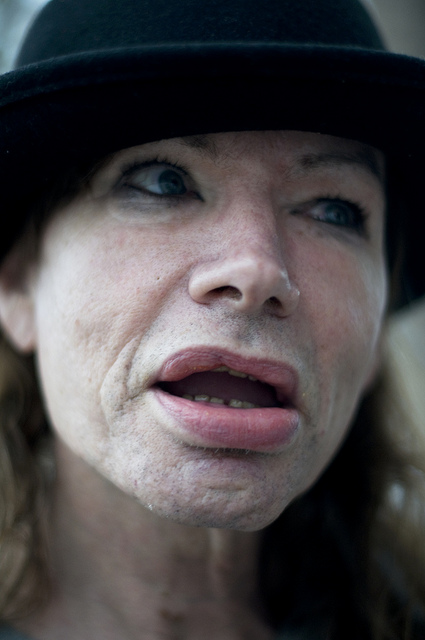
This picture does not contain the lipliner, which appeared to be eyeliner around the lips, applied without benefit of a mirror.

In addition to being a fat girl and a blonde, I happen to have the penultimate two lines of my favorite poem tattooed on the inside of my right forearm: “I have promises to keep/ and miles to go before I sleep.”  She squinted at them for a few seconds.

“It’s from Robert Frost’s ‘Stopping By Woods on a Snowy Evening.'” I said, and she heartily approved.

She said several times that she stole (“But they know I steal,” she said, gesturing vaguely at the staff. “So I guess it serves them right,” I said.) and that she lied. She asked me to guess whether she was lying when she said that her grandmother was Betty Grable and I thought it might be possible. Then she asked me to guess whether she was lying when she said that her grandmother was Joan Crawford. I have to say, that face had some very nice bones going on, and good skin, too (“Burt’s Fucking Bees,” she said at least five times during the conversation “Get it at Walgreen’s”) but I told her that she couldn’t be the grandchild of both of them. She maintains that she’s Joan Crawford’s grandchild.

She asked me my favorite color, my favorite song, and when she asked the Pirate his favorite punk band and he said he liked X, she lit up. We talked about Exene Cervenka, and she claimed that Exene wrote the intro to her book. But she had come in claiming that someone else had written it, so I filed that in the same bin as Betty Grable and Joan Crawford grannies.

“I’m drunk, sorry.” Visuals travel faster than either sound or smell, but all three had already told us that.

She complimented my shoes and told me that she knew a guy who did custom-made shoes and Marilyn Monroe dresses. She told me that she’s a submissive. That whenever she has trouble coming, all the man has to do is snap his fingers and she comes instantly because she’s so submissive. That Marilyn Monroe was so submissive, she’s dead. I laughed so hard that she got up and said it again into the microphone at the front of the room. And it was funny then too. She approved of my dress and my shoes and my tattoos and my hair, and told me, when I sang a bit of my current favorite song (Regina Spektor’s Samson) that Adele had nothing on me. Nothing, I pointed out, but a few Grammys.

She turned her chair to face us and kept leaning forward and taking my hands. She said that she likes women, but she loves men, and who can blame her? At one point, she said something about Bambi, then said “I’m Bambi, by the way.” But I had figured that out already.

She insisted that I closely inspect her art deco earrings, telling me to put out my hands so that she could cup them in hers and place the earrings in them. I wouldn’t have called them art deco. They looked more 50s vintage, but they were fun, no doubt. Although, I have to say, not as fun as the amazing pearl starbursts I got the little kid as part of her Audrey Hepburn costume.

Meanwhile, every time she got up to get more of the wine and cheese on offer, the Pirate and I looked at each other and started cracking up. This is not the first time that someone with an alternative take on reality has zeroed in on me as a kindred spirit, and, for the life of me, I do not understand why.

She had put her jacket on the back of the chair next to me, but was still sitting in the chair in front of me when three of my friends arrived. One took a seat behind me, but I practically had to beg the other two to sit next to me, moving Bambi’s jacket back to her chair. We made introductions all around because it would seem rude not to, and everyone’s comments were surprisingly tame. This is a pretty snarky crowd.

Bambi went back into the bookstore proper and returned with a large softcover coffee table book with the world “men” in the title. Inside were various pictures of men next to pictures of likely places of manly pursuits. There might be a closeup of a 20-year-old with a deep tan and a 3-day beard next to a picture of a pristine beach with a Jet-Ski sitting on it. That sort of thing. The Pirate looked at it and said “Oh, look. You brought us a catalogue.” We paged through it and said things like “I could use one of these in the kitchen” while Bambi cackled and promised to get a lady catalogue for me. I was fine, though. I’d like one of those for the kitchen as well.

Then Scott got up to read, and things started to go south.

The opening scene of Big Egos takes place at a party full of dead celebrities. As Scott read, Bambi stage-whispered in that way drunken people do, “Name dropper.” One of the staff came over and asked her to be quiet. Bambi got up and made her drunken way back into the bookstore, returning with some paperback and accidentally knocking some cups off the table that held the wine and cheese. By now everyone in the room was very determinedly watching Scott’s reading and Not Looking at Bambi, and something became clear to me.

Bambi knew that everyone was looking away. She counted on it.

As she came back to her seat at the front, she stood up for a few moments, blocking the audience’s view of Scott, who never stopped reading. She pouted her lips and tucked her hair behind her ears and posed, and I drew my eyebrows together and shook my head just a little, trying to communicate “I was feeling kindly disposed toward you earlier, but don’t blow it by behaving badly toward a friend that I like better than I like you.”

She sat down and, without trying to be subtle in any way, proceeded to put the book into the depths of her backpack. Scott finished his reading and asked if there were any questions. Bambi demanded to know if Scott actually knew any of the people he wrote about. Of course he doesn’t. “Well I knew all of them,” Bambi said, and then proceeded to tell Scott that his writing was shallow and affected and terrible. At this point, a male staffer came over and told her she needed to leave. “Call the cops” she growled. “Okay,” he said, and went off to make the call.

She was fidding in her backpack, getting her self together when one of Scott’s burlier friends yelled from the back “Come on, honey, it’s time to go.” At this point she was standing up, and she yelled “Who are you, fat boy?”

“Nobody, but it’s time for you to go. Let’s take it outside.”

“I have to go,” she growled at the crowd. “The cops are coming.” The she looked at the bookstore staffers, who were handling the whole thing with the aplomb that I assume comes of working at a bookstore in the Haight and said “Fine, you want me to leave, I’ll leave.” And with that, she threw some chairs around and walked out.

The room was silent for a few more seconds before Scott said “Are there any other questions?”

After the reading, which couldn’t help but be a bit anticlimactic, my friends told me that they assumed that Bambi and I were old friends by the way we were interacting, and I admitted to only having just met her when she attached herself to me upon arriving. A man told us that he’d known Bambi since he was 18 (he looked to be in his mid-30s) and that Bambi was “a character.”

But nobody seemed to have noticed what happened. The book went into the backpack, in full view of everyone, but when she was ejected, everyone was so relieved to have her gone that I’m sure nobody bothered to remove it, which, I realized, was the entire point. What better way to create a distraction from one misdeed than with another, larger misdeed? If this had been a movie, everyone would have been cheering for Bambi.

As it was, I was the only one in that crowd, and my cheering was all internal. Go, Bambi. You’re brilliant.

And, for the record, Exene Cervenka did write the intro to Bambi’s book.

I’m the Monster

It’s been a while since I posted, but I have a good excuse. I published the newest issue of Lunch Ticket, did the last stuff I needed to do for my grad school residency, and drove down to Los Angeles.

I’m down here for ten days at a time, and I’ve gotten fairly good at packing. But I’ve never been so good at packing that I haven’t forgotten something crucial and had to hit the Target near the school.

Being in Los Angeles is kinda nice. It’s anonymous. Back home, I see people I know everywhere – at the supermarket, at the gym, at every restaurant I frequent. Here at this Target, nobody knows me. It’s like being invisible or wearing a mask.

I took my purchases up to the bank of registers, but out of twenty or so registers, only four were open, each with a line of at least five people. Everyone shifted from foot to foot, looked at each other, thumbed their phones. The woman in front of me looked at the long lines off to our right and remarked to her husband that she hated this Target because it was always crowded. As I turned my head to look at the crowd, a tall Native American-looking man two registers over turned toward me. His mouth dropped open, and he reached up with one hand, as though about to point to the ceiling.

The man’s shorter brother put an arm around the man’s back, and as his hand encircled the taller man’s waist, the tall guy’s head began to shake. His arm twitched, and his legs folded under him. With a practiced motion, the brother gently guided him to the ground.

That’s when I noticed that the brother, who now stood guard over his shaking, drooling sibling and told
Continue reading

See Me, Feel Me, Touch Me, Heal Me

“Don’t see me!”

My 6-year-old nephew holds his hands over his face. He’s angry because I teased him, and his punishment is to withhold himself from me. “Don’t see me.”

I admire my nephew for being able to be angry. For being able to look at someone who’s an authority figure over him and say that he’s angry and that they deserve punishment. I admire him because he can do something I can’t. When I’m confronted with authority, I can’t express anger. In fact, I can’t even feel it.

I used to work for a large company. My boss was very social and the two of us split the work of our department up between us – she schmoozed her superiors and made PowerPoint presentations, I did the actual tasks. She regularly told me that if I didn’t like working there, I could quit.  That I, a glorified marcomm dork in a job that paid over $100k a year and came with great benefits, could just waltz out of that office and find another job. In tech writing. During a recession.

I had frequent discussions with my boss about the source of our disconnect, but she never saw it as a disconnect. She saw our inability to work together as something I did on purpose, as though I was a different person outside of work – one who loved social gatherings, cats, and knitting – and just chose to be introverted, sarcastic and OCD at work to piss her off.

In these confrontations, she would tell me that my task execution was fine, but she hated everything else about me. I didn’t come to work early enough – she got up at 5 so she could be at work by 7. I didn’t stay at work long enough – she never left before 5:30. I didn’t interact enough with people from other departments – she scheduled meetings and lunches and get-togethers with other departments. I didn’t act happy enough – she acted like every day was a birthday party. Every word she spoke had the same meaning: Why can’t you be more like me?

She’s not the only person in my life who has excoriated me for being the person I am. My parents, my teachers, every authority figure in my life took me to task at some point for not being more social, for not being more cheerful, for not being more extroverted.

There was never a way to express my frustration with adults. As a child, I didn’t know words like “introvert” or “circumspect,” so I didn’t have any way to defend myself. I couldn’t explain that I hated big crowds. That being dragged to parties with people I didn’t know made me anxious and exhausted. That my bad moods weren’t just me being willful, but because I was overstimulated and unable to escape. And without a defense for my bad behavior, I was guilty as charged.

When you’re little, it’s easy to feel hopeless and sad because the adults around you don’t understand you. It’s commonly thought that the reason children in the “terrible twos” are so cranky all the time is that their reasoning ability outstrips their ability to communicate, leading to frustration. What happens when that inability follows you throughout your whole life? What happens when it’s not your ability to communicate that’s lacking, but the willingness of those around you to listen?

It takes a sense of power to feel angry. To express anger, a person has to start with the belief that they’ll be understood by the person they’re talking to. But when you’ve been misunderstood your whole life, you don’t have that. Anger gives you courage; to take away anger is to dis-courage.

I moved away from my family and quit that job, but I still struggle when it comes to feeling that I have the right to be the person that I am without explanation or justification. I struggle with the feeling that I could pour out a sea of words, and they would never be enough, because what I need isn’t for people to listen to me.

What I need is for them to see me.

Baby Names

It seemed, growing up, that people didn’t have a lot of imagination when it came to baby names. For instance, in my freshman history class of 30 kids, 6 of us had the same name. That’s 20% answering in unison when our name was called. It meant that for my entire school career, my name was always followed by my last initial.

Of the 6 of us, I don’t see very many similarities. One of us was tall and fair skinned with long, curly blonde hair. Another was willowy and freckled and loved hiking. Yet another was a cheerleader with eyes so dark they appeared black. I was the chunky drama geek, and I barely remember the two others. And that’s just in one class. There were other girls with my name in other classes, as though everyone named their daughters the same thing that year.

And while I can’t find any similarities among women with my name, I have noticed similarities among people with other names. So many that I find it a bit eerie sometimes. Here is a partial list of those things that, in my opinion, people with the same name share. When I call out a particular name, I am including every spelling variant of that name. For instance, when I say “Catherine,” I also mean Catharine, Katherine, Kathryn, etc.

Theresa: This is the first name that I began encountering often as a child. What the name means to me now is someone who has in the past or will in the future, date or marry someone I have dated or married. Almost without exception, every man I have been with in any romantic capacity has also been with a woman named Theresa. I have not met most of these women, and I’m sure that most of them are perfectly nice people.

Stephanie: All the Stephanies I know are kind of self-absorbed. They don’t really do anything that isn’t in their own self-interest. Even when it looks like they’re doing something charitable, there’s always a hidden reason behind it that’s less public-spirited. And most would argue that this is not a bad thing.

Kyle: All the Kyles I have known have been solid, working-class guys who wear baseball caps and get sunburnt necks.

Keith: All the men I know named Keith are black. That wouldn’t be strange except all the black men I know are named Keith. Except one. Who should probably change his name.

These are just the ones that occur to me off the top of my head. I know where are more. I wonder if I’m the only one who notices this.

Buy Me a River

Quick, what’s the first thing you think of when you hear me say “Lange & Söhne Grande Lange 1”?  How about “Keith Lloyd”?  “Flora Danica”?  Or “Kallista Archeo Copper?”

If you are a normal person, you don’t think anything. These things have no meaning to you. And why should they? If you wear a watch, you likely wear something that was either a gift to you, or something you bought for less than a year’s wages, a brand that you’ve heard of – Timex, Swatch – something like that.

You also would have no reason to know that Keith Lloyd makes bespoke suits for men, that Flora Danica is the world’s most expensive china, or that if you want a Kallista Archeo Copper tub, you’ll be shelling out $70k for it.

I had to look these names up. I don’t have any of these things, and I don’t know anyone who does. When writers put details like these into a work, they may think that they’re adhering to “show don’t tell,” but if what you’ve shown me is something I can’t comprehend, you’ve just failed.

I’ve railed about the laziness of using brand names as description before, but in the wake of the news that another Dan Brown potboiler is coming down the colon, I felt it time to mention it again.

The High Cost of Writing

I know lots of people who can write anywhere. They go to coffee shops, libraries, they get up at four in the morning and write at their kitchen tables. I know other people who have some theoretical set of conditions under which they can write, but they can’t articulate what they are and can only point out what they are not. As in “I can’t write in my apartment. It’s not the right space.”

I don’t really have either problem. There’s writing I can do anywhere, and I do. I’ve had days where I’ve cranked out 10,000 words and still had time to do fun stuff afterward. Lately, though, getting time and space to write has been hard.

When I wrote a piece about a musician, I sang all the time. When I wrote about a woman who leaves her parents’ home to have an affair with a married man, I fought with my parents. I’m not the sort of person who has to go out and do something before she can write about it, but I do tend to take on the emotions of my characters.

It’s taken the occasional toll on my marriage. You see, my husband loves me. He loves me in that “can’t watch me suffering without trying to make me feel better” way. He also works from home, just like I do, and occasionally, he needs to ask me something or tell me something or show me something. Knowing that he could come walking in any second makes it difficult to really lose myself in writing scenes that require some extremes of emotion. If I’m writing anger, I’ll yell at him. If I’m writing a sex scene, I probably won’t get much more writing done.

The piece I’m writing now is full of self-doubt, loneliness, longing and fear. On Monday, I took advantage of being alone in the house for five hours to get some work done. I put on the playlist that I reserve for the project I’m working on, I re-read the stuff I had already written, and I thought about what had to happen next. And then, I began to cry. I kept blowing my nose and wiping my face with my handkerchief, but within fifteen minutes, it was soaked. So I got another. And another. My shoulders were shaking, my breath hitching in my chest, my lips were getting chapped from the hanky. Every once in a while, I had to stop typing because I had to put my head down on my desk and howl. Then, back to typing.

After a couple of hours, I had finished three thousand words. I had a whacking headache, my face was red and swollen, I had run out of clean handkerchiefs and I was exhausted. My family came home, but it was hard to enjoy their company. For all my exhaustion, I couldn’t fall asleep, though. Being over-emotional does that to me.

It wasn’t until the next day, after a wasted morning of trying to work but not being able to concentrate on much, that I gave in an napped. And when I say “gave in and napped,” I mean “passed out on the couch in my office.”

I admonish myself for not writing as often as I should, but if every couple of hours of productivity costs me a day of down time, I think I should be a little easier on myself.

No Elves Allowed

I had a conversation with a friend from my MFA program today. We’re both reading slightly different stream-of-consciousness novels and wondering how everyone started re-writing Mrs. Dalloway. I feel like so much of what I read in the program is derivative of something else – Hemingway, Faulkner, Pynchon, Woolf (although, funnily enough, not Proust or Tolstoy). Everyone’s writing realistic fiction, trying to frame events that we’ve all experienced first- or at most, second-hand with a voice that makes them sound relevant and urgent and more important than anything in real life.

The whole “voice” question comes up all the time in our studies, and in things related to our studies. In the magazine I edit, I had one editor question the “voice” of a first-person essay because she didn’t think that the author’s “voice” matched the actual story of her own experience. Seriously, that’s fucked up.

And it occurred to me that when I’m reading genre fiction, I almost never worry about voice. For that matter, I don’t worry about a whole lot of the conventions of “literary” fiction, because all that matters when you’re reading a genre story is the story. This is why books like Twilight and 50 Shades of Grey sell bazillions of copies, even though everyone in the world acknowledges that they’re barely literate rubbish: people like the stories they tell.

I haven’t read either of the books above, because I like my story to come passably well-written as well as thought-provoking, so I end up reading really good sci-fi, fantasy, horror, and magical realism authors, and I always end up thinking “I would love to write like this.”

Did I mention I’m getting my MFA? And you’d think that, since I’m in a program specifically meant to make me into a better writer, I’d have a chance to hone and perfect that, right? The problem is that there are good mentors in our program – mentors who are attentive readers, willing to give really in-depth, line-edit feedback to my writing. There are also mentors who really like experimental writing and genre fiction. There is precious little overlap.

Many of the mentors claim that they don’t “understand” the conventions of genre fiction, but I’m not sure that they’re any different than the “conventions” of any other kind of fiction. Tell a good story. Have compelling characters. Build some tension. Does it matter exactly how vampires work? No. Everyone who’s ever written a successful vampire book has made up their own rules, but as long as those rules are consistent within themselves, no one minds. Does it matter whether your fairies (or, if you insist, faeries) are good or evil? Nope. Whether robots are our friends or enemies (or both)? Not a bit. Whether the aliens can pass for human? Nah.

What I’ve always loved about genre fiction is the way it explores what it means to be human by juxtaposing humans with other things and thinking about those differences. I’m not convinced that humans are the strongest, smartest, most compassionate species in the galaxy (which is how we’re always portrayed, which, as a trope, embarrasses me) but I like thinking about what makes me human as opposed to robot or vampire or elf queen. Because when I think about what makes people human, I get to think of all people at the same time. All races, all genders, all religions, all classes and nationalities. They’re all included.

Maybe I’d have liked Hemingway if there’d been more spaceships and fewer guys fishing. Maybe Faulkner would have appealed more to me if there’d been less racial tension and more species tension. Maybe I’d like Woolf more if there were fewer first-world problems, and more multiverse problems.