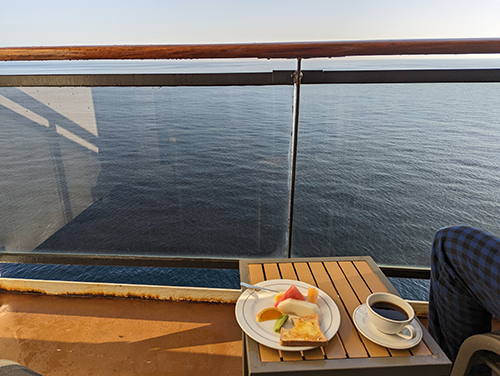
After being stuck on buses with a zillion other people and visiting crowded tourist destinations, we were feeling DONE. We decided to order breakfast in and spend a relatively lazy morning hanging out on the balcony. I made some tea and took my breakfast outside, where I immediately put my feet up on the railing and sipped my tea with a contented sigh. I could actually feel myself unclench.
Living my best Toast Life!
Day 35:
I spent most of today working on work stuff. It’s really hard, because the wifi on the ship is really spotty. Every time I’m in the dedicated lounge set aside for World Cruise folks, there’s always a queue of mostly old ladies complaining to the concierge about how they can’t get on the wifi. The concierge probably has a script for this situation, since it seems to happen 17 times an hour.
Day 36:
I spent all today doing work stuff while the Pirate stayed in our cabin, because he’s now in the throes of the same creeping crud a lot of folks on the ship have had. It’s annoying, because on every shore excursion, there have been people on the bus coughing like they’re bringing up their internal organs (we call them “Hacking Nancies”).
All of them seem oblivious to the fact that they’re making everyone else sick. One woman, after a truly wet, disgusting, loud round of coughs, looked at everyone defiantly and said “Well, I don’t feel bad.” It’s no surprise to us that about a week ago, the captain announced that there had been an increase in COVID cases. Suddenly we were no longer allowed to dish up our own food at the buffets, and they started being a lot more strict about making people use the hand sanitizer before going to the buffet.
Day 37:
I’m exhausted. For the last few days, we’ve had to set our clocks ahead an hour every day. Right now, we’re 14 time zones away from where we started in California. Today, I woke up at what was 4am just a few days ago. I hate being woken up early. It always feels like a punishment. I also dislike the feeling of sleeping all day and so missing out on events and getting things done. It’s weird to exist in a world where days are 23 hours long. I can hardly wait until the return journey, where our days will be 25 hours long, and I can get an extra hour of sleep without missing a thing.
Day 38:
Today, I was looking through the program and saw that there was a matinee of Gulliver by the theater troupe Box Tale Soup. I’d seen in the program that it was a puppet show, and I thought it would be fun. It turned out to be more than fun. It wasn’t just a puppet show – there were three live actors playing all the parts, with one guy being Gulliver and the two others both playing characters themselves and using some puppets that weren’t the normal person-in-a-box, hands-above-head kinds of puppets, nor were they marionettes. They were more like articulated dolls, manipulated by the cast members like puppets. The staging was really clever, and the original music (all done a cappella) was really lovely.
The ship they’re talking about in the video is the ship we’re on right now. If you ever happen to be where they are, absolutely check them out!
Day 39:
Tomorrow is Penang, Malaysia, but now it’s my turn to be ill. I want to go on our field trip, since it’s to a spice garden and a butterfly farm. We’ll see how well that works out!
Today, we visited the capital of Oman, Muscat. In both Abu Dhabi and Dubai, we had the same tour guide who constantly told us about how everything in those two sultanates was “the best.” Our guide in Muscat had no such claims. He was every bit as proud of his country, but Muscat isn’t the artificial glitz and excess of the last two places.
Our tour guide instead directed our attention to the many schools, parks and hospitals. He extolled the wisdom of the Sultan that passed away in 2020 for his vision in investing in infrastructure. I am far more impressed with Oman’s hundreds of added schools than I am with the tallest building in the world.
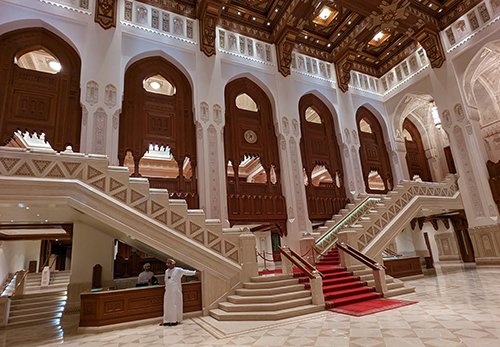
We visited the Royal Muscat Opera House, which, although smaller than San Francisco’s War Memorial Opera House, has some really impressive features.
Lobby of the Royal Muscat Opera House
First, the seats in Muscat are FAR more comfortable than San Francisco’s – a fact I ascribe to their being newer. Also, because the opera house is also used for concerts and theater, the layout is impressively flexible.
The elaborate teak proscenium can be moved back to make room for an enormous pipe organ that can be moved forward. The boxes nearest the stage can be rotated and moved back. The first four rows of seats are on a platform that can be moved down and covered over to become an orchestra pit. The ingenuity is amazing.
Although there was precious little going on today (another day at sea), evening was another matter. Another gala evening, but this time, we decided to dress up and at least go to dinner. While I think the Pirate is forbiddingly handsome all the time, the Pirate in a tuxedo is next-level handsome. We went to dinner at our regular place, where we have a table next to the window.
Toward the end of dinner, the Pirate pointed out the window – “Look!” The waves in the wake of the ship glowed with phosphorescent algae. As the waves formed under the surface of the water, a long line of bright cyan showed where it would break the surface. As the waves broke, the line of light limned the crest, and continued for at least 30 seconds after the wave had disappeared. The light would re-appear every few seconds, moving outward in the ship’s wake, dashed luminescent lines extending as far as we could see behind us.
The Pirate and I stood on our balcony for quite a while, hypnotized by the sight. I thought about trying to get video, but decided against it for two reasons. First, I am not a good enough videographer with my phone to trust that I would actually capture the sight. Second, I believe that not everything needs to be recorded. I like the idea that I will have to call this to mind unaided later. “But you won’t remember it perfectly,” you might say. Correct. And that’s a large part of the beauty.
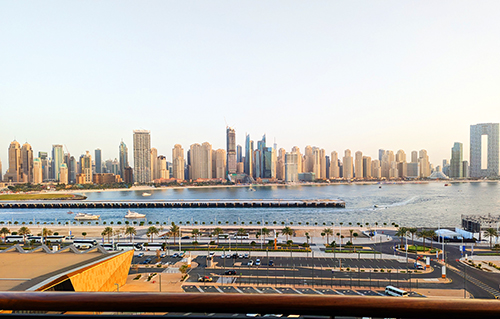
Yesterday, our tour guide told us that when we woke up in Dubai, we’d have an amazing view of the city. He wasn’t wrong. It was still dark out when we got up, and the city was breathtaking. It’s like the scenic skyline of every major city in the world, all crammed into one small place.
Our tour today was to The Museum of the Future. One thing I’ve learned from reading a lot of science fiction is that aliens always choose the author’s home culture to land in, and the author’s home culture is always that one that’s going to save earth. The Museum of the Future follows that same pattern – the UAE is going to save the world with its superior innovation.
In some ways, it was like a theme park ride. First there was the part about the orbiting space station, where visitors got to check out all the parts of the space station, and look at the various jobs, and see the various fictional projects this fictional space agency is undertaking. To me, it was a weird mélange of various other scifi stories and franchises I’ve seen – aspects of the S. A. Corey series The Expansion, snippets from Torchwood, a whole lot of Disney.
Junior space explorer suit, with no functional elbows
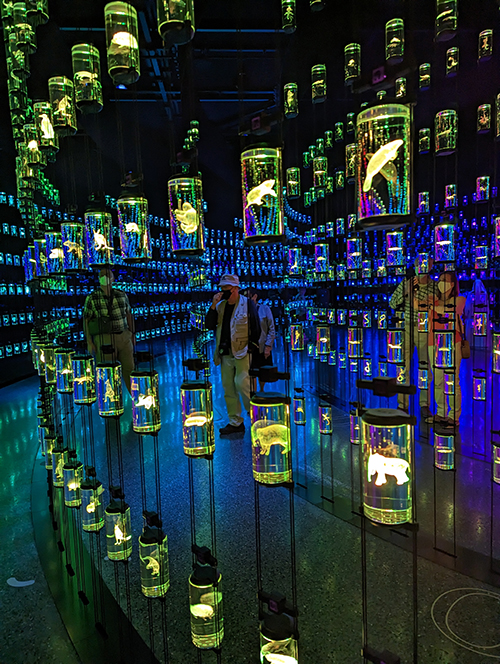
From there, on to the conservation area. The best part of this was a huge room called the “genetic library.” It contained three concentric circles of “specimens,” arranged in jars in columns. The “specimens” were color coded by phylum. The jars were actually cylinders of acrylic with holographic representations of animals and plants in the middle of each. The overall effect was really cool.
Next was the wellness area, which was really the most fun. There was a large, dark room with a semi-circular area against one mirrored wall. The floor swam with dots of light, and everyone stood around the outside, staring down. As I entered the room, the guide said “It’s a motion exhibit.” She gestured to the area of floor, which I took to mean “walk on it.” So I did. It was great! The floor was a little squidgy, but the best part was that the swirling patterns of tiny dots moved in waves away from wherever my feet landed. I hopped, slid my feet along, took huge steps. Then I discovered that if you put one arm out away from your body, the light would scatter from the shadow of your arm as well. It was great.
As usual, I’m already late!
Then we went to Palm Island – a manmade island in the rough shape of a palm tree that now hosts the most expensive real estate in the world. The guide was full of superlatives – everything was the biggest, the tallest, the most expensive, the best. He kept saying that “everyone in the entire world wants to live here.” I think that he’s right in one respect – everyone on earth wishes that they had enough money to buy a place here. But they don’t actually want to live here.
Palm Island, so called because its shape resembles a palm tree
One hilarious thing I noticed was that as the tour bus drove along, the guide narrated the sights along the way. Whenever we drove by a building or street that looked less than opulent, he would quickly direct our attention to something interesting on the other side of the bus. It didn’t take me long to start automatically looking out the other side of the bus from where he pointed.
While a lot of Dubai is impressive, it all made me sad. It’s not sustainable. The rate of building here, the kind of consumption it takes to build a city like this in such a short time, the fact that literally everything – every plant, the soil, the building materials, the consumer goods, the talent that keeps the city running – everything has to be imported. It’s hard not to look at all this and see what it’ll look like in 100 years, derelict and reclaimed by the desert.
Day 31:
We didn’t have any shore excursions today, but after all the amazing food we’ve had, we both wanted to go to the spice market and see if we couldn’t score some spices to take home and experiment with.
Our first adventure was getting a cab. Our tour guide yesterday said that 99% of taxi drivers accept contactless payments, so we hopped in a cab confident that we would be able to pay by credit card. Nope.
We went to the ATM and realized that neither of us had brought our debit cards, so we couldn’t pull cash. No problem – we can just use our credit cards to get a cash advance, right? No. You need a PIN, and neither of us had one. We tried calling our bank to see if we couldn’t set that up, but we couldn’t even get a call to go through. Ugh. We’ll figure something out.
We went into the spice market, which is a warren of tiny shops selling spices, teas, rugs, caftans, and various touristy dreck. The spice shops all had baskets and bowls arranged in ranks, and the merchants had a novel approach to selling. They all asked us to guess what various berries, leaves, crystals, threads, dried fruits, and powders were. We got sunflower threads, oregano, ginger, hibiscus, frankincense. We didn’t know indigo or sulfur, which both looked like sidewalk chalk. The big surprise came when the guy held up a white, cylindrical crystal and asked us to guess what it was. We had no clue. Salt? Quartz? He then lit the kind of tiny charcoal brazier used for incense and put the crystal on it. He asked me to close my eyes, and gently blew the smoke toward me.
When burning menthol hits your nostrils, it can burn the hair right out of them. Any congestion I may have had was gone.
From the spice market, we went to the gold market. My tastes are on the minimalist side, so things like a necklace of what looked like chain maille made of gold links that would hang to a person’s waist is so far overboard that it’s on its own island. There were earrings that I would have thought were bracelets, bracelets that I would have thought were some kind of magic futuristic handcuffs (they may be – I don’t know), and necklaces that could be worn as aprons. A lot of the bigger pieces were probably 9 carat gold and so had a very brassy, cheap look to them.
Each of these rings is the size of a ping pong ball.
What was really funny to me were the men who kept approaching us with what looked like business cards with pictures of handbags on them, asking us if we wanted handbags, and then started rattling off names of designers. Whenever someone offers me a knockoff watch or purse, I think of that scene in Home Alone where Catherine O’Hara is offering to give someone her watch in exchange for their plane tickets. The person asks if it’s a real Rolex, and O’Hara says “Do you think it is?”
We ended up working everything out with the cash-only cab driver, and everything turned out fine. I’m excited to have some tea options that aren’t limited to Darjeeling and the nasty stuff that is just labeled “English Breakfast,” but tastes more like the sweepings from the floor of a second-rate tea production facility.
We spent today in Abu Dhabi. I did know that Abu Dhabi was part of the United Arab Emirates, but I wasn’t sure what that meant. What it means is that there are seven independent states ruled by hereditary Sheiks that have banded together into a single bloc. Internally, they are entirely separate and have nothing to do with one another’s politics, but they join up (like Voltron) when dealing politically with other countries.
I talked in my post on Egypt about how Karnak Temple was a monument to “Ramses II is so amazing and everyone loves him.” Abu Dhabi goes that one better – it’s an entire country dedicated to “King Zayed is so amazing and everyone loves him.” Zayed Port, Zayed Museum, Zayed Mosque – everything has his name on it, and his picture is everywhere. He welcomes you to the mall, he waves at you on the freeway, he greets you from the harbor. What’s hilarious is that his face is either the face of every romantic lead in 1930s desert films, or the villain in every 1980s action movie.
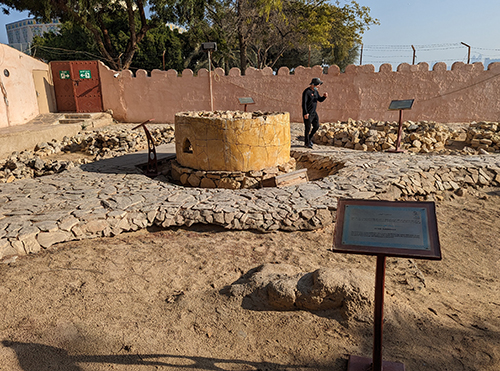
We visited a “heritage village,” which is about what you’d expect – the same as every historical model village in the world. “Here are the local handicrafts. Here are the local agricultural products. Here is the local infrastructure.”
Here are the local reconstructed ruins.
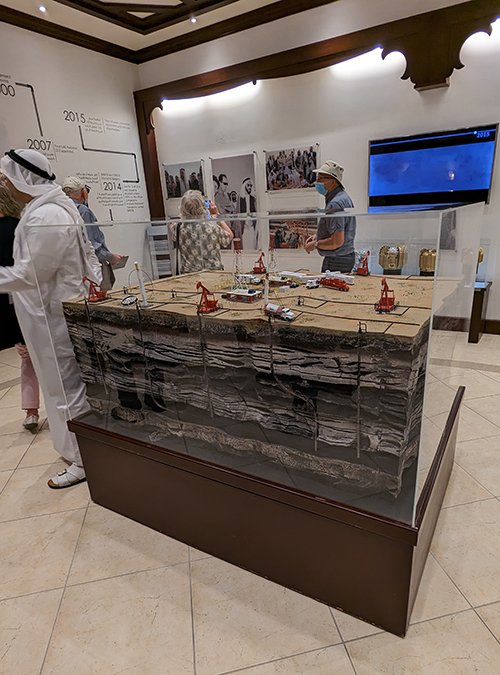
Next up, a museum that was mostly closed so that all we could see were the parts dedicated to “check out how King Zayed influenced oil drilling,” “check out King Zayed’s amazing postal service,” and “check out King Zayed’s crack police force.”
This is the inspiration for many Great British Baking Show cakes.
Last, we went to the mosque. This part was saved for last because this is the most amazing place I’ve never heard of (then again, as has been mentioned elsewhere, what I don’t know about the world can and does fill an entire set of encyclopedias). This mosque is on a scale with Karnak Temple – several world records were made in its construction, including a record for the largest carpet, the largest chandelier, and the highest mosque dome.
Just to get to the mosque, you have to start at a dome across the street.
Even the entry dome is beautifully filigreed.
You take the escalator down one floor and go through an entire mall, complete with the most important coffee shops of the English-speaking world: Starbucks, Costa, and Tim Horton’s. Then you go through security where they not only make sure you’re not hiding a knife, gun, or bomb, but they also make sure you are correctly dressed. For men, it’s only long trousers. For women, it’s trousers or a dress that goes down to the ankle, sleeves that cover the entire arm to the wrist, no transparent fabrics, nothing tight or form-fitting, and a head covering. We were told not to wear white and found out that it’s not because white is forbidden, but because white is often transparent. Our tour guide had us put on our scarves on the bus and went down the rows making sure we were all correctly covered.
Once inside the grounds of the mosque, the tour is like a cattle drive. There is a delineated path tourists must walk that takes them through the outer courtyard, then into the room with the enormous carpet and chandelier, then back out and to the visitor’s center. It used to be true that if women weren’t correctly attired, they could borrow a head scarf or caftan, but since COVID, they’ve stopped that practice. They also stopped making people take off their shoes, instead putting down a plastic walkway to ensure that the carpet and amazing marble floor is not damaged.
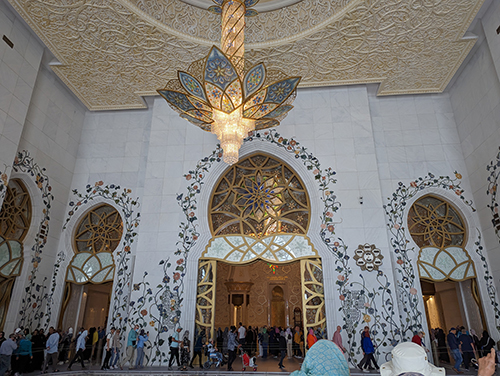
This is the inner entryway – the outer entryway is even larger.
Again, it’s almost impossible to describe the scope of this mosque. And it’s all marble, gold, semiprecious stones, and crystal. The sheer wealth expended in just this building is more than my mind can easily take in.
A couple of days ago, we got a note saying “if you’re doing the city tour of Abu Dhabi, you must observe a strict dress code for entrance to the mosque.” Most of the requirements weren’t surprising: loose-fitting clothing that covers the leg down to the ankle and the arm down to the wrist, nothing transparent, head coverings for women. I was surprised, though, that you’re not allowed to wear white or animal prints. I hadn’t heard that before, and it meant that I had to re-think my original outfit, which involved short sleeves and then an oversized white shirt. It also means that I will spend the day in a hot country wearing all black. What could go wrong?
Today is another Gala evening, this one Roaring 20s themed. We dressed for the first couple of gala evenings, but by the third one, getting dressed up to have our pictures taken and then going to a giant party where 2700 people are competing for 1000 seats lost its allure.
I’ve never been one for parties, especially parties where I don’t know anyone, and sitting in a room with over a thousand other people and trying to have a conversation is more stress than I find enjoyable. I finally realized that this is just like any other party. I can NOT GO! And I don’t even have to feel bad about it! So the Pirate and I had a lovely dinner where we didn’t have to talk to anyone else, then were back in our room by 8.
Day 28:
After Southampton, the ship collected our passports so they could arrange all the customs stuff for us, but not every country will allow us to enter with just our cruise ID. In Egypt, while the customs officials stamped our passports before we got them back the day before, we still had to show them to a customs official as we got off the ship.
Today, we have to collect our passports in advance of being in Abu Dhabi tomorrow. And it’s not just the people getting off the ship who have to show their passports to the officials – every single person on the ship has to get off, show their passport, and then those that don’t have shore excursions booked can get back on.
We also found out that we have to secure our own visas for Singapore, but that you can’t apply for the visa more than 3 days before you arrive. I anticipate that the ship’s limited wifi is going to be strained past its limit in the 3 days leading up to Singapore. We have to get our own visas for Australia too, but at least we can do those any old time.
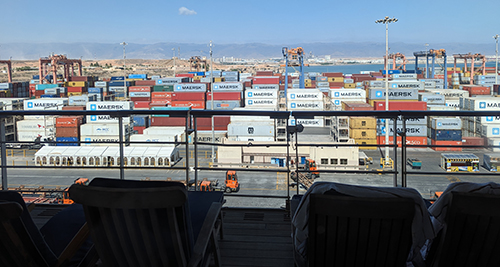
We’re in Salalah, Oman. We didn’t book any port excursions because the only one that looked interesting was full by the time we got around to booking. Salalah, whose current claim to fame is that it’s the main container shipping port for this part of the world, doesn’t have a cruise port terminal, and there’s nothing interesting one might walk to. Most of the view from our ship is of the container loading dock. It’s like staying in Long Beach near the Queen Mary.
On one of my favorite podcasts, one of the hosts occasionally talks about “when I lived in Scotland.” They are referring to having spent 3 months in Scotland doing the Fringe Festival, which is hardly “living in Scotland.” Three months isn’t even the limit of a tourist visa. But if that person can claim residency for three months, it means that I will be able to say that, once upon a time, I lived on the last ocean liner in the world.
We’ve joined the Guest Choir on the ship, and today is the day before our performance. Every leg of the trip, a new choir forms, practices for a few days/weeks, then gives a performance in the Grand Lobby. So, our performance is tomorrow, and the choir directors have decided that today was the right time to introduce a new song.
It was also Burns Night. The ballroom had a large selection of malts on offer, and the Scottish officers of the crew gave all the traditional readings/speeches/toasts. It was great fun, but I can see why there weren’t very many Americans. If you’ve never heard or read it before, spoken Scots can be hard to follow, and the crew doing the readings had some impressive accents. Afterward, there was the traditional singing of “Auld Lang Syne,” where everyone held hands. That always kind of chokes me up.
Day 23:
And today, the performance of the choir. We had one last rehearsal at 11am, with the performance to follow at 3pm. The only guidance we were given for clothes was “black and white,” and the men’s section leader said he’d be wearing his tux.
When we came down at 2:45pm, nearly all the men were wearing tuxes (including the Pirate), and all the women were wearing lovely dresses or slacks. We got to stand there for 10 minutes, getting more and more nervous as the crowd coming to see us swelled in size. The Grand Lobby is a big circular area on Deck 2, with curved staircases running up each side to Deck 3. The choir stood on Deck 2 opposite the staircases, so we had an excellent view of the crowd forming on the stairs and around the upper rail of the atrium.
We were told that this is the largest Guest Choir they’ve ever had – about 80 people total. We joked that, if the choir continues to grow, everyone on the ship would be singing, and the audience would consist of 3 maintenance guys and a customs official.
As often happens, the actual performance sounded better than any of our rehearsals — for the rest of the evening, we were celebrities. It seemed like much of the staff and a lot of the passengers saw the performance, and everyone congratulated us on doing such a good job.
Day24:
Absolutely nothing happened today. I took a nap to celebrate.
Day 25:
Today is the Pirate’s birthday. Most of the day was very low-key, which was a good thing. I overheard someone else talking about how this was now the longest amount of time he’d ever been on a cruise, and I realize it was the same for me. The longest cruise I’d been on before now was three weeks, and we’ve passed that.
Dinner was Indian food at the schmancy restaurant, and it didn’t disappoint. While the appetizers and mains were excellent, the desserts were confusing. There were three tiny desserts – a carrot halvah, something that looked like crème patissiere on a tiny rectangle of toast, and something that tasted like the kind of mousse one makes by combining pudding and whipped cream (in this case, banana pudding), except this had vermicelli in it. Because who doesn’t love surprise pasta, right?
I’ve mentioned that many monuments and famous sights are a letdown — smaller, less colorful, less impressive than their hype would suggest. The sights we saw in Egypt were an incredible exception. If anything, they were larger and more impressive than I could ever have given them credit for.
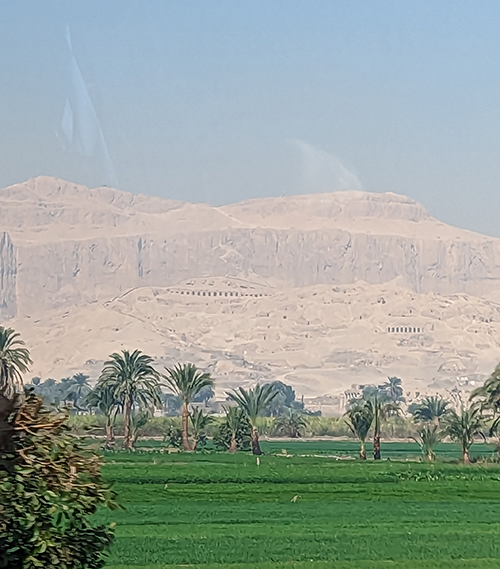
Tombs outside Valley of the Kings – just a few of the incredible number of tombs in the area
We started at the Valley of Kings. Our guide, who was not allowed to enter the tombs with us, talked a lot about what we’d see. The most interesting thing was that she talked about the Egyptian visions of an afterlife where one will be judged according to their good and bad deeds. Christians believe the same thing, but the Christian God is omniscient, and therefore knows even before you die, all the things you’ve done.
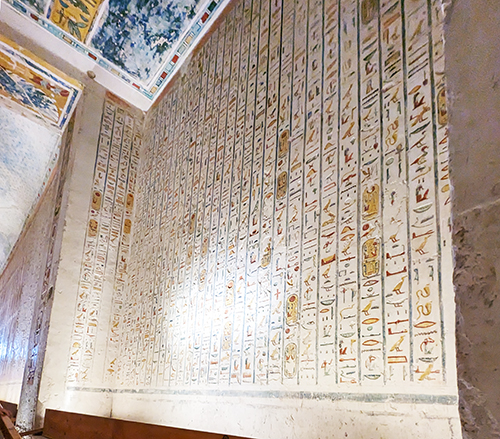
This is all propaganda telling why Ramses IV should get into heaven
Egyptian gods are less efficient. Much of the writing on the tomb walls was a long list of all the entombed person’s good deeds, which was supposed to persuade the relevant gods that the person was worthy. Like Christians, Egyptians believed in a day of judgement when all the dead will be called to account, and that nobody knew when that day might come. Egyptians didn’t believe in reincarnation – they believed in resurrection. They preserved all the bodily bits because after judgement, worthies would be re-installed into their earthly bodies and allowed to live again for eternity. I’ll be honest, that sounds like kind of a crummy deal to me. If I’m going to spend eternity in a fleshly body, I’d like one a little younger, healthier, and better-looking.
Another fascinating thing was the amount of ancient graffiti, left by people as early as the first Greeks to come to Egypt. I’ve read about ancient graffiti in other sites, and it’s apparently very much the same as graffiti nowadays – “Bobacles was here,” “Joeacles is a jerk,” “For a good time, call Shirlyacles.” Tourists are only allowed to venture a few yards into each tomb, as most of them are still being excavated.
Onto Karnak Temple, which was awe-inspiring. First, we drove by Luxor Temple, about a mile away. Most of it has been lost, but what remains is still impressive. Monumental, in every sense of the word – built to the glory of kings that styled themselves as gods, on a scale that would ensure that no one would ever doubt their significance.
Leading away from Luxor Temple toward Karnak Temple is an avenue of small-ish sphinxes (maybe 5 feet tall, including their pedestals) that originally stretched the entire distance, but much of which was destroyed to make room for more modern development. I was surprised to learn that most Egyptian antiquities didn’t have any kind of meaningful governmental protection until the 1960s or 70s.
Karnak Temple is an experience that comes in waves. First, there’s a pair of 30-ish foot towers, each stone several tons, and all fitted together perfectly. The towers were built without any kind of mortar, and the stones were cut before they were put into place, meaning that everything had to be precisely calculated and measured prior to being placed – perhaps the saying “measure twice, cut once” originated with the Egyptians? Outside the temple wall was another wall of slightly more modern Roman origin – built hundreds of years after the temple, but in much worse repair.
On the left, the original wall of Karnak Temple, and on the right, a Roman wall built hundreds of years later. They just don’t build them like they used to.
Inside the first towers was a courtyard with ram-headed statues lining either side, and 15-foot statues of Ramses II. Actually, the theme of the entire temple was “Ramses II is the most amazing guy ever,” even though much of it was built during his father’s reign. Apparently, Ramses II had a tendency to carve his name into statues of his predecessors, and carve them deeply enough that they couldn’t be carved over, which led to him being known as “the thief of history.”
The Pirate and me in front of two of the zillion ram’s head statues, each with a little guy in front of it. They seemed to say “This is my tiny guy. There are many like him, but this one is mine.”
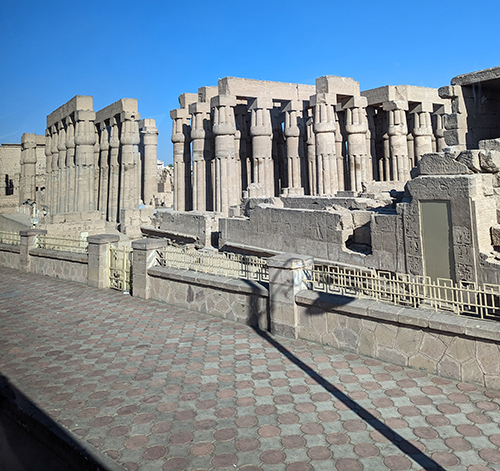
After another pair of towers is an extraordinary area that used to be two rows of 30-foot columns with two rows of 20-foot columns on each side. The two rows of shorter columns originally supported a roof, which has been lost, and there are the remains of stone-framed windows on top of them. The tops of the shorter columns resemble closed flower buds, and the tops of the larger columns resemble open flowers, highlighting the centrality of the sun to Egyptian spiritual life. Back when it was entire, the side arcades would have been sheltered from the sun and heat, but the central arcade would have been flooded with sunlight, highlighting the friezes carved on the columns. Standing in the middle of it, I felt the same sort of smallness and humility in the face of grandeur that I felt in Sagrada Familia, which similarly uses themes of organic life and light to express appreciation for the sacred.
But incised into every surface of that inner colonnade was writing that extolled the virtues and triumphs of Ramses II – lists of tribes he’d conquered, friezes showing him acting as high priest (one of the king’s responsibilities) in various ceremonies, friezes highlighting his godly lineage. The inside was covered in religious imagery, but the outside was covered in friezes showing him in his military aspect. Scenes of him in battle, slaying his enemies; scenes of him leading captives back to Karnak to be sacrificed; scenes of his enemies begging for mercy and making offerings to him. One entire wall is covered with a peace treaty between Ramses II and the Hittites.
I left the temple knowing that I’d need some time to process all that I’d seen. I want to go back, just to spend a lot more time understanding what I saw.
Today, we traveled by bus from Safaga to the Valley of Kings. Because we were up at dark o’clock, I had hoped to catch some sleep on the 3 ½ hour bus ride, but that wasn’t going to happen. Our guide wanted to give us a very full picture of Egyptian history, culture, and politics, and since she would not be able to enter the tombs at the Valley of Kings with us, she wanted to talk about what we’d see inside the tombs.
We went through Qena and Luxor, and I was surprised by the lack of infrastructure. There are canals that channel the Nile out to water the small-scale agriculture that looked like about half of it was commercial, and the other half the household gardens of the people who lived there.
Other than the main road we were on, there were very few paved roads. While there were a few private cars, most people were on motorcycles, donkey carts, or bicycles. In fact, donkey carts were about half the traffic.
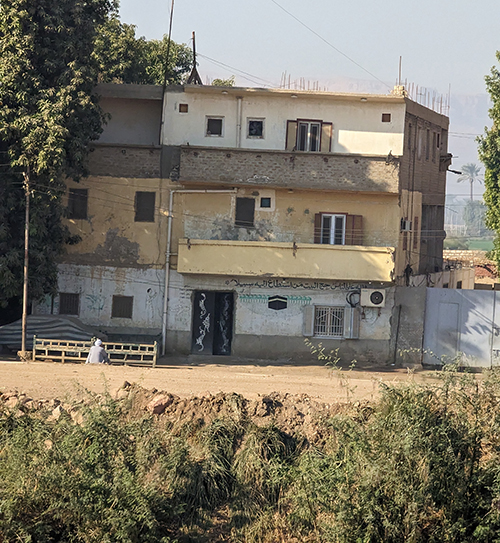
About two-thirds of the houses were concrete blocks or bricks, but a third were mud bricks with porches shaded with what looked like chaff from sugar cane, which is the largest commercial crop in the area. A lot of the houses looked as though they had been built as one-story structures, then later they added a second story while still living on the first floor, and then later added another floor. In the picture below, you can see rebar sticking up from the roof where they will add another floor. About half the concrete structures were like that.
The banks of the canal were full of garbage in a way that made it clear that it was the main method of waste disposal. I was surprised that I didn’t see a single large shop of any kind on the way there. I saw the kind of tiny stalls that sold a little of everything, but no large shops offering clothing, pharmaceuticals, hardware, or anything else one might expect to see in such a large population center. Mosques are the tallest buildings in the landscape. The minarets of these mosques can be seen from anywhere in the town, and all had loudspeakers on them.
On the way back, the town looked entirely different. It was dark by the time we drove back through Qena, although it was only about 6pm. Now the road seemed to be lined with small shops and restaurants. There were lots of people in the streets shopping, talking, walking home or waiting or a bus. The neighborhoods we’d seen during the day that had no paved roads also seemed to be largely without electricity, with one notable exception: the tall tower on every mosque bore several rings of bright-green neon. In neighborhoods with many mosques, it looked almost like Las Vegas.
I’ll post about Valley of Kings and Karnak Temple separately.













 I Love You But Fuck Off